Microservices Clean Architecture CQRS DDD
A .NET 8 microservices architecture demonstrating Clean Architecture, Domain-Driven Design (DDD), and CQRS with automated architecture tests, integration tests, and event-driven distributed coordination. This repository provides a complete, functioning microservices implementation that teams can learn from and adapt.
Repository: CleanArchitecture-DDD-CQRS-Microservices on GitHub
Original Template: CleanArchitecture-DDD-CQRS
Introduction
This repository contains a Computerized Maintenance Management System (CMMS) implemented as microservices. It demonstrates how to build maintainable, testable, and scalable microservices using Clean Architecture, DDD, and CQRS patterns.
The CMMS domain is perfect for demonstrating microservices patterns because it has:
- Clear business boundaries (Work Orders, Technicians, Assets) that map to services
- Complex business rules (assignment constraints, status transitions) requiring proper domain modeling
- Rich domain models with encapsulated behavior
- Real-world scenarios that teams can relate to
Philosophy
This repository demonstrates that implementing microservices with Clean Architecture, DDD, and CQRS doesn't have to be complex. It shows how to apply these patterns pragmatically in .NET—with enough structure to maintain boundaries and enable testing, but without over-engineering.
Perfect for:
- Teams building enterprise .NET microservices with CQRS and DDD
- Developers learning how to implement microservices patterns
- Architects evaluating microservices implementations
- Technical leads enforcing architectural boundaries through automated tests
Design Principles
- Domain-First Design - Business logic lives in the domain, not in services
- Explicit Boundaries - Each layer and service has a clear purpose and dependency rules
- Testability by Design - Every component can be tested in isolation
- Pragmatic CQRS - Separate read/write models where it adds value
- Architectural Governance - Automated tests prevent boundary violations
- Service Autonomy - Each service owns its data and can evolve independently
Key Features Overview
This repository includes implementations of enterprise patterns working together in a microservices architecture:
Core Architecture
- Clean Architecture layers with dependency inversion (Domain, Application, Infrastructure, API)
- DDD tactical patterns (Aggregates, Entities, Value Objects, Domain Events)
- CQRS: EF Core for writes, Dapper for reads, flexible read sources
- Repository pattern with Unit of Work
- Custom Mediator: No MediatR dependency, full control over CQRS pipeline
Microservices Patterns
- Database-Per-Service - Each service owns its database ensuring autonomy
- Event-Driven Communication - Services communicate via events through RabbitMQ
- Outbox Pattern - Guaranteed event delivery with at-least-once semantics
- Saga Orchestration - Distributed workflows coordinated by orchestration service
- Shared Contracts - Immutable event schemas for type safety across services
Event-Driven Architecture
- Dual Event Handlers:
IDomainEventHandler(transactional) +IIntegrationEventHandler(async) - Outbox Pattern: Guaranteed event delivery with transactional consistency
- Cross-service coordination via integration events
Reliability & Consistency
- Optimistic concurrency control with SQL Server RowVersion
- Result pattern for consistent error handling
- Pipeline behaviors (Validation, Transaction, Logging, Events)
- Saga compensation for distributed transaction rollback
Quality & Documentation
- Architecture unit tests: Automated tests enforcing DDD/Clean Architecture boundaries
- ADRs: Documented architectural decisions — see Architectural Decision Records
- Unit tests for Domain & Application layers across all services
- Integration tests: Testcontainers-based end-to-end scenarios
Architecture Diagrams
High-Level System Architecture
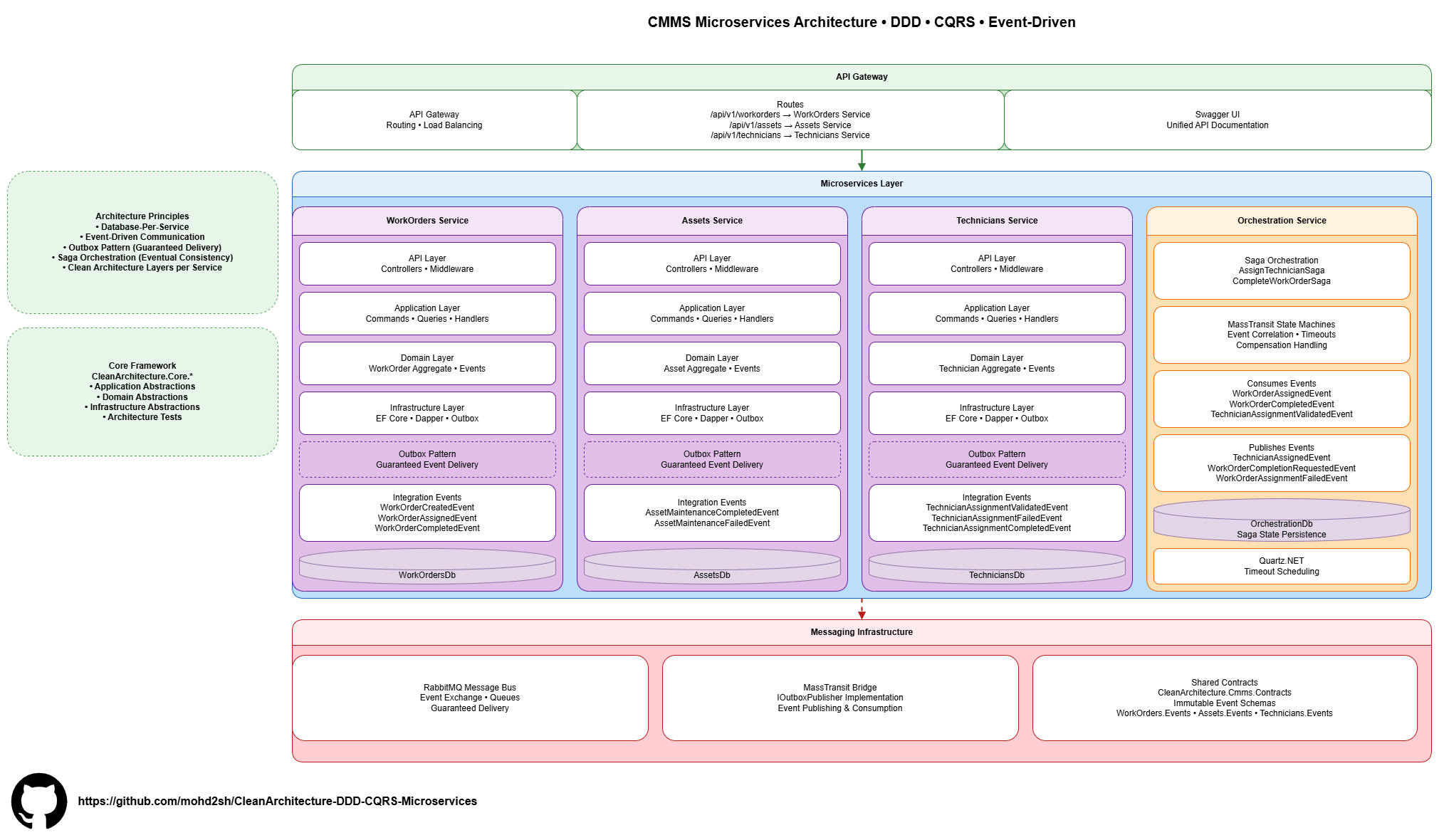
The system architecture demonstrates a microservices implementation with four main services:
- WorkOrders Service - Manages work order lifecycle, handles creation, assignment, and completion. Publishes events when work orders are created, assigned, or completed.
- Assets Service - Manages asset information and maintenance status. Responds to work order events to update asset status and tracks maintenance history.
- Technicians Service - Manages technician information and availability. Handles assignment tracking and validates technician assignments.
- Orchestration Service - Manages distributed workflows using saga pattern. Coordinates multi-step operations across services and handles compensation for failed operations.
Each service follows Clean Architecture with Domain, Application, Infrastructure, and API layers. Services maintain their own databases (WorkOrdersDb, AssetsDb, TechniciansDb, OrchestrationDb) ensuring service autonomy and independent scaling.
Services communicate asynchronously via events through the message bus. The Orchestration Service manages distributed workflows using the Saga pattern.
Assign Technician Flow
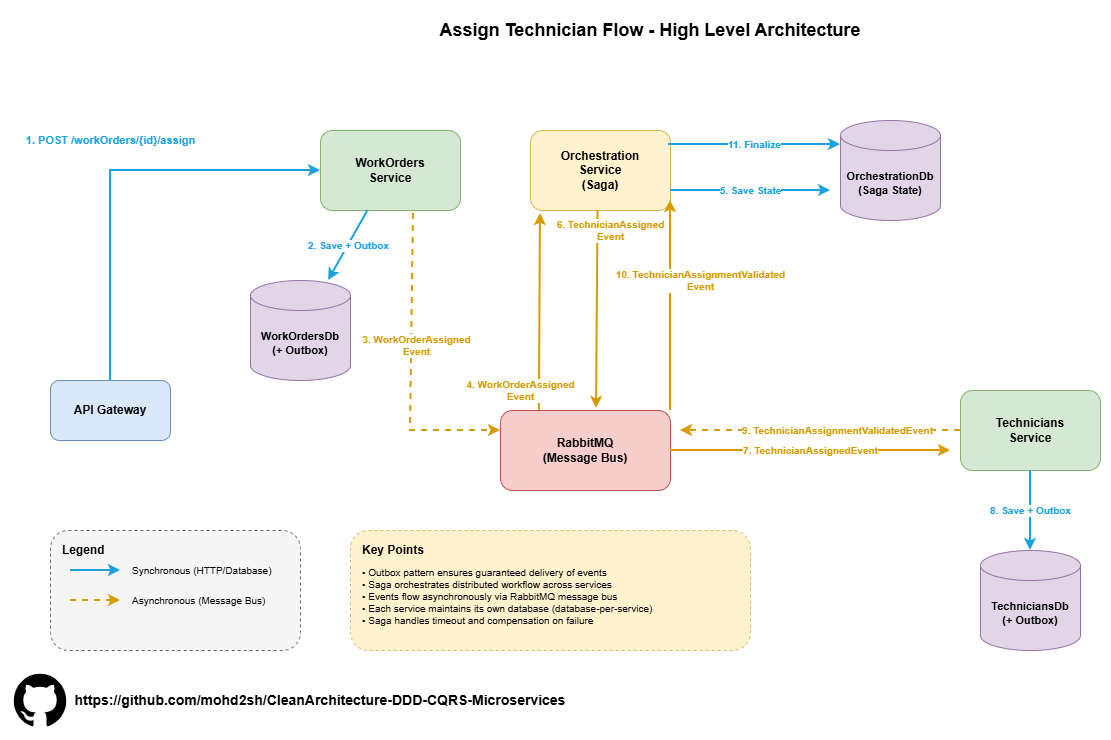
This diagram illustrates the complete flow for assigning a technician to a work order. The flow demonstrates the outbox pattern for guaranteed delivery, saga orchestration for distributed transactions, and eventual consistency across services.
Architecture Tests
The repository includes many architecture tests that automatically enforce DDD principles and Clean Architecture boundaries across all services. New team members can work confidently—architectural violations are caught at compile-time through automated tests.
Architecture tests are available as a reusable NuGet package (CleanArchitecture.Core.ArchitectureTests) with base test classes that can be inherited in your projects.
Domain Layer Protection
Immutability & Encapsulation:
ValueObjects_Should_Be_Immutable- No public setters allowed (init-only setters are OK)ValueObjects_Should_Be_Sealed- Prevents inheritance and maintains invariantsAggregates_Should_Have_Internal_Or_Private_Constructors- Enforces factory methods
Type Safety:
DomainEvents_Should_Be_Sealed_And_EndWith_Event- Naming conventions enforcedDomain_Types_Should_Be_Internal- Prevents domain leakage to outer layersDomain_Should_Not_Depend_On_Other_Layers- Dependency rule enforcement
Application Layer Boundaries
Layer Isolation:
Application_Should_Not_Depend_On_Infrastructure_Or_Api- Clean Architecture enforcementCommands_And_Queries_Should_Be_Immutable- CQRS contracts are immutable
Read/Write Separation:
QueryHandlers_Should_Not_Use_IRepository- Queries forbidden from using write-side repositoriesCommandHandlers_Should_Not_Use_IReadRepository- Commands forbidden from using read-side repositories- Why: Enforces CQRS separation at compile-time, prevents accidental coupling
DTO Boundaries:
Handlers_Should_Not_Return_Domain_Types- Handlers must return DTOs, never domain entities- Why: Prevents domain model exposure to API clients
Bounded Context Isolation:
Application_Features_Should_Be_BoundedContexts- Features cannot depend on other features- Dynamically discovers all aggregates and validates feature isolation
- Why: Maintains bounded context boundaries within the application layer
Service Boundaries
- Services cannot depend on other services' internals
- Shared contracts ensure type safety without coupling
- Architecture tests enforce service autonomy
Benefits
For New Developers:
- No need to memorize architectural rules
- Violations caught immediately during development and PRs
- Clear error messages explain what's wrong
For Teams:
- Prevents architectural degradation over time
- Self-documenting architecture constraints
- Confident refactoring with safety net
- Ensures service boundaries remain respected
For Code Reviews:
- Automated enforcement reduces review burden
- Focus on business logic, not architecture violations
- Consistent patterns across all services
Evolution from Monolith to Microservices
This repository evolved from the original CleanArchitecture-DDD-CQRS template. The original template was designed with microservices in mind from the start, which made the evolution straightforward.
What Made the Original Template Microservices-Ready
1. Outbox Pattern Abstraction
The original template implemented IOutboxStore and IOutboxPublisher abstractions. This made swapping from in-process handlers to message bus integration trivial. The same code that worked in-process now publishes to RabbitMQ via MassTransit.
2. Event-Driven Architecture
The dual handler system (IDomainEventHandler for transactional events, IIntegrationEventHandler for async events) translated directly to microservices. Integration events that were handled in-process now flow through the message bus to other services.
3. Bounded Context Isolation
Architecture tests enforced strict boundaries between bounded contexts. When we split into services, these boundaries were already respected, preventing cross-service coupling.
4. Database-Per-Service Structure
The original template used separate database schema for each domain, and with no direct reference between domains/schemas. This structure naturally evolved into database-per-service.
5. Clean Separation of Concerns
Domain, Application, and Infrastructure layers were clearly separated. Each service maintains this structure independently.
6. Architecture Tests
Automated tests enforced boundaries at compile-time. These same tests now ensure services don't accidentally depend on each other's internals.
Original Template
The original CleanArchitecture-DDD-CQRS template provides the foundation for how DDD and CQRS are built. We used the core NuGet packages from there for the abstractions and bootstrapping template code. For detailed documentation on DDD patterns, CQRS implementation, architecture tests, and other template features, see the original template repository.
Inter-Service Communication
MassTransit Bridge
We use MassTransit as a bridge on top of our outbox pattern. The CleanArchitecture.Outbox.MassTransit.Bridge package implements IOutboxPublisher to publish events to RabbitMQ.
Why MassTransit?
- Open-source solution suitable for demos and development
- Good integration with .NET
- Supports RabbitMQ, Azure Service Bus, and other transports
The outbox pattern abstraction from the original template made this integration straightforward. We swapped the in-process publisher for a MassTransit publisher without changing any business logic.
Shared Event Contracts
The CleanArchitecture.Cmms.Contracts project contains immutable event schemas shared across services:
WorkOrders.Events- Events published by WorkOrders serviceAssets.Events- Events published by Assets serviceTechnicians.Events- Events published by Technicians service
All services reference this project to ensure consistent message contracts. Events are versioned and immutable once published.
Event Flow
- Service publishes integration event → written to outbox table (same transaction)
- Outbox processor picks up event → publishes to RabbitMQ via MassTransit
- Other services consume from RabbitMQ → invoke integration event handlers
- Handlers update local service state
This ensures guaranteed delivery with at-least-once semantics.
Orchestration Service
The Orchestration service manages distributed workflows using the saga pattern. It coordinates operations that span multiple services and handles eventual consistency.
Saga Pattern
Sagas manage long-running transactions across services like:
- AssignTechnicianSaga - Coordinates technician assignment validation
- CompleteWorkOrderSaga - Coordinates work order completion across Assets and Technicians services
Eventual Consistency
Operations that require coordination across services are eventually consistent:
- Work order completion triggers parallel updates in Assets and Technicians services
- Saga waits for both services to complete
- If one fails, compensation events are published
Compensation Events
When operations fail, the saga publishes compensation like for example:
WorkOrderCompletingFailedEvent- Triggers rollback in participating servicesRevertTechnicianAssignmentRequestedEvent- Reverts technician assignment
This ensures system consistency even when operations fail partway through.
MassTransit State Machines
Sagas are implemented using MassTransit state machines, which provide:
- State persistence
- Timeout handling
- Retry
- Fault handling
Cross-Service Query Challenge
One challenge in microservices is querying data across service boundaries. Each service has its own database, so traditional joins aren't possible.
The Problem
In WorkOrderReadRepository.cs, we need to display work orders with technician and asset names. In a monolith, this would be a simple join. In microservices, the data lives in different databases.
Current Approach (TODO):
The implementation returns empty strings for cross-service data fields. This acknowledges the limitation while we evaluate solutions.
Future Approach:
CDC (Change Data Capture) with Debezium streaming from SQL Server to Elasticsearch. This provides:
- Service autonomy (no cross-database dependencies)
- Optimized read models
- Eventual consistency
- Better scalability
We have a separate demo repository showing the CDC approach with Debezium.
Key Design Decisions
1. Database-Per-Service
Each service owns its data. This ensures:
- Service autonomy
- Independent scaling
- Technology flexibility per service
- Clear ownership boundaries
2. Event-Driven Communication
Services communicate via events, not direct calls:
- Loose coupling
- Better scalability
- Resilience to service failures
- Natural evolution path
3. Outbox Pattern
Integration events written to outbox in same transaction:
- Guaranteed delivery
- At-least-once semantics
- Survives application restarts
- Works with any message bus
4. Saga Orchestration
Complex workflows coordinated by orchestration service:
- Manages eventual consistency
- Handles compensation
- Provides visibility into distributed operations
5. Shared Contracts
Immutable event contracts shared across services:
- Type safety
- Versioning support
- Clear service boundaries
- Compile-time validation
Architectural Decision Records
The original template's ADRs (ADR-001 through ADR-006) documented foundational patterns that enabled this migration.
New ADRs for microservices:
- ADR-007: Message Bus and Saga Orchestration Framework Selection - MassTransit vs NServiceBus comparison
- ADR-008: Cross-Service Query Patterns - Options for querying data across service boundaries (Status: Open/In-Progress)
Quick Start
Prerequisites
- .NET 8 SDK
- Docker Desktop
- Visual Studio 2022 or VS Code
Docker Compose
The easiest way to run all services:
git clone https://github.com/mohd2sh/CleanArchitecture-DDD-CQRS-Microservices.git
cd CleanArchitecture-DDD-CQRS-Microservices
docker-compose up
Access:
- API Gateway: http://localhost:8000
- Swagger UI: http://localhost:8081
- RabbitMQ Management: http://localhost:15672 (guest/guest)
Local Development
Run services individually:
# WorkOrders Service
cd src/services/WorkOrders.Service/CleanArchitecture.Cmms.Api.WorkOrders
dotnet run

# Assets Service
cd src/services/Assets.Service/CleanArchitecture.Cmms.Api.Assets
dotnet run

# Technicians Service
cd src/services/Technicians.Service/CleanArchitecture.Cmms.Api.Technicians
dotnet run
Each service requires:
- SQL Server connection string
- RabbitMQ connection string
Testing Strategy
Unit Tests
Each service has unit tests for:
- Domain logic and business rules
- Application command/query handlers
- Architecture boundaries
Run all unit tests:
dotnet test --filter "FullyQualifiedName~UnitTests"Integration Tests
Integration tests use Testcontainers for:
- Real database testing (one per service)
- End-to-end scenarios across services
- Event flow validation through message bus
- Saga orchestration testing
Run all integration tests:
dotnet test --filter "FullyQualifiedName~IntegrationTests"Architecture Tests
Automated tests enforce architectural boundaries at compile-time. These tests run as part of the unit test suite and prevent:
- Service boundary violations
- Layer dependency violations
- CQRS separation violations
- Bounded context coupling
What's Not Included
This repository focuses on architecture and design. Cross-cutting concerns that are out of scope:
- Authentication/Authorization
- Secrets management (Key Vaults, etc.)
- Distributed tracing
- Monitoring and alerting
- Production infrastructure
TODO
Future improvements and enhancements:
- Complete Kong API gateway configuration and routing
- Cross-Service Query Patterns
- Add Orchestration unit tests and integration tests
- Enhance health checks with database and RabbitMQ connectivity
- Event versioning strategy
Contributing
Contributions welcome. This repository serves as an architecture reference and learning resource.
License
MIT License - see LICENSE file for details.
Built to demonstrate microservices architecture patterns in .NET